Part II · Chapter 21
Exporting Services
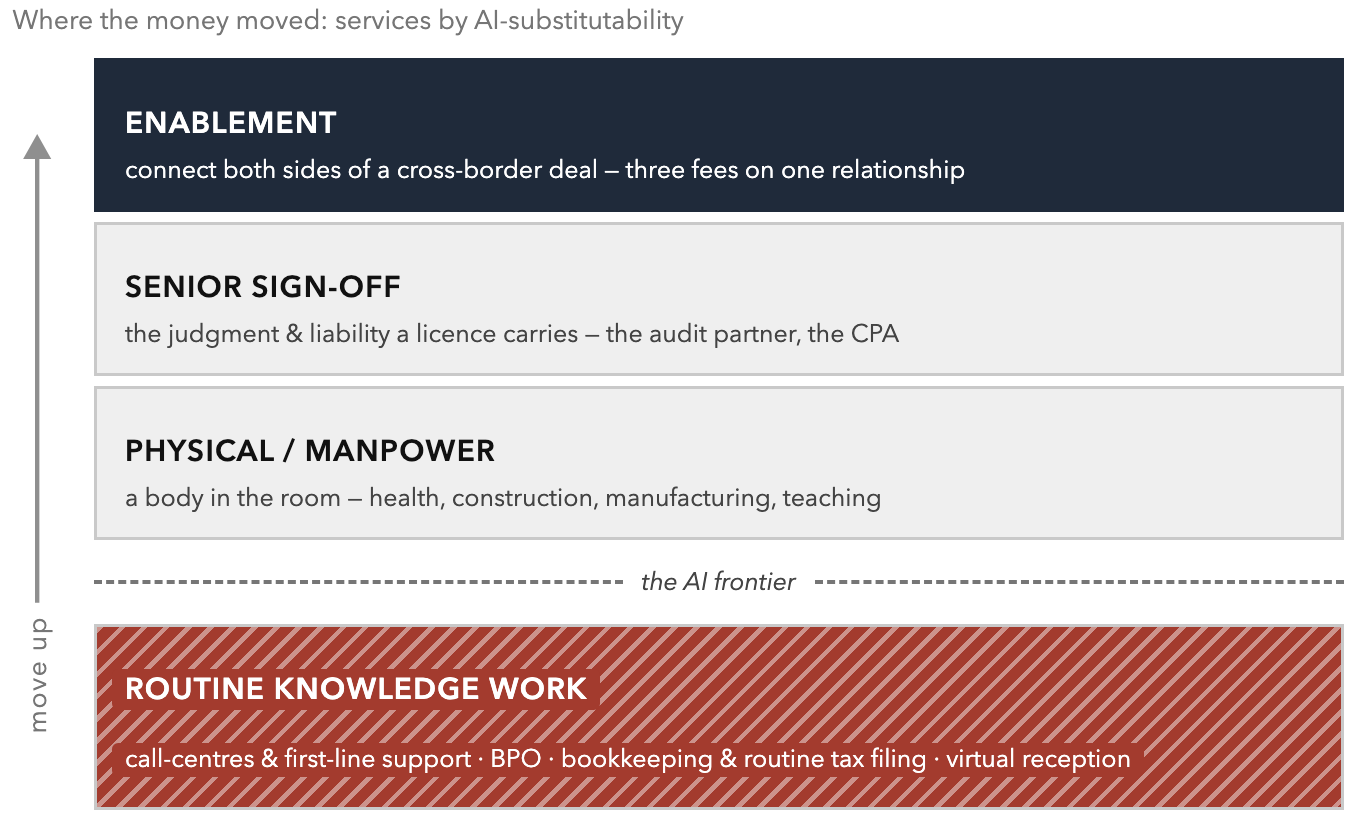
What can an Indian professional sell abroad without shipping anything, and which of those businesses will last? This chapter is for consultants, accountants, architects, engineers, clinicians and agency owners, who already hold the cheapest way into global trade. It opens with a motel receptionist and hospital monitors staffed from Manila, then argues that the wage gap which built India's services boom is the very thing automation now attacks. It sorts the services trade into six clusters and studies the ones that hold up: accounting work for British, American and Australian practices, training and placing nurses and workers in short-staffed economies such as Japan and the Gulf, and bringing foreign patients to Indian hospitals. It looks at software work in East Africa, Japan, the Gulf, Europe and Australasia, and at the ways an entrepreneur can earn from the captive centres foreign companies run in India. It closes on the tax and payment paperwork a services export still needs. Afterwards you can judge which services business is worth building from India now, and which is already being priced away.
Key ideas
- India's services trade grew on a cost advantage, and that advantage is the first thing machines erode; what lasts is work that needs presence, a signature or a bridge between two countries.
- Selling a skill to a foreign client is trade in the full sense, with an invoice, a currency and a customer abroad, even when nothing passes through a port.
- In placing workers abroad, language decides what scales: a factory team can work under one fluent supervisor, while care work needs every worker to speak it, so training cost shapes the business.